

Everything in the world has a price.
Not only objects, but also experiences, time, information, and even relationships carry their own price tags. While living with the knowledge of this fact, we occasionally encounter items that make us tilt our heads in confusion. Ripped jeans are an example of such items.
Ripped jeans, literally, are torn and worn-out clothes. Thinking common-sensically, they should be cheaper than intact jeans, but reality is the exact opposite. Sometimes, the more they are ripped and the more boldly they are worn out, the higher the price rises. Why do people spend more money to buy ripped jeans? What exactly has turned this clothing into an “expensive garment”?
I have held onto this question seriously, and for a long time in my life. Not just as a fashion major, but as someone who once lived in a land where jeans themselves were forbidden.
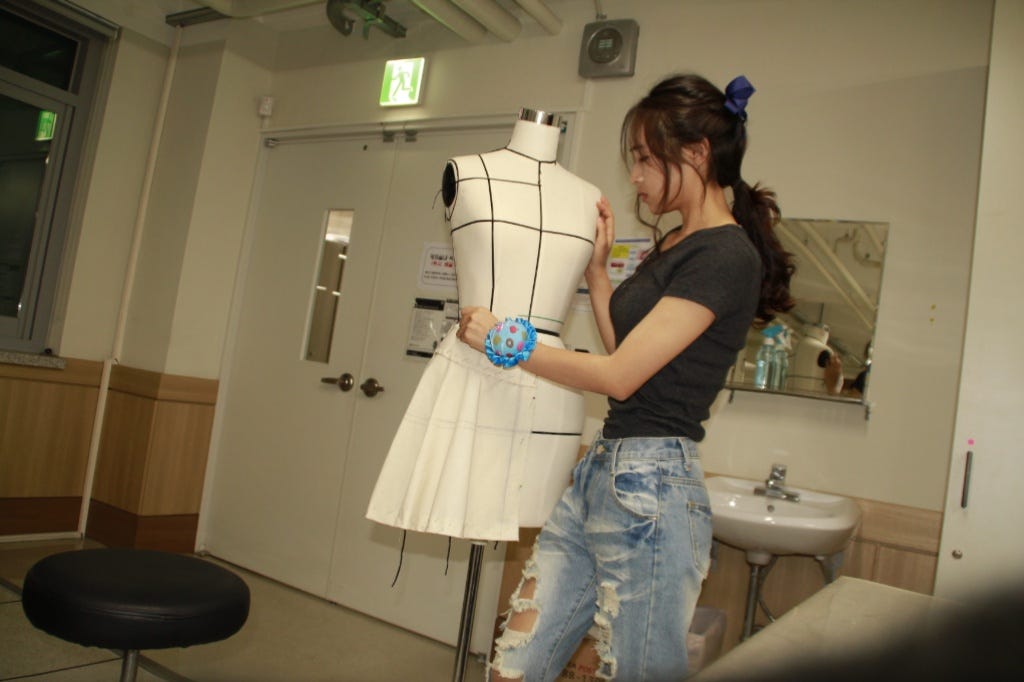
What “Clothing” Means in North Korea
In the northern part of the Korean Peninsula, north of the 38th parallel, jeans are not just an item of clothing in North Korea. Jeans were defined as symbolizing America, capitalism, and reactionary culture, and naturally became objects of prohibition. Jeans are not just a single piece of clothing; they become subjects of crackdown as a symbol of “ideological pollution.”
Even just about 15 years ago, clothing in North Korea had a greater meaning as functional “equipment” to endure the four seasons, rather than for “style.” An outer coat to endure the winter, pants that could be worn for a long time without ripping, shoes that would not easily wear out—thus, clothing was the minimum equipment to aid survival. Therefore, to North Koreans, “ripped clothing” was a symbol of shame, a snapshot of poverty, and a trace of deficiency that had to be hidden. Ripped clothes had to be mended somehow, patched up, and filled.
Roughly 20 years ago, during a trip to Mount Baekdu, seeing a foreigner wearing ripped jeans for the first time, I came to know that “ripped jeans” were not a symbol of poverty but a ‘style,’ “individuality,” and a symbol of “freedom.” This scene became a symbol for me that jeans were not just pants, but a forbidden world and an unreachable freedom, causing me to constantly desire the free world, and ultimately became the reason I am living in South Korea today.
Why Did Ripped-ness Become a ‘Value’?
The reason ripped jeans are expensive is simple. It is because it is a matter of meaning, not a matter of the fabric. Fashion has long reinterpreted and projected the problems and changes of society. Bent lines became avant-garde, worn-out cloth became vintage, and ripped denim became a symbol of freedom, resistance, and street culture.
1. ‘Meaning,’ Not the Cost of Production, Makes the Price
The washing process of removing color from jeans and ripping them is much more complex and higher in cost than general apparel manufacturing. In particular, to create a naturally old-looking—that is, faded and worn-out—appearance, additional processing costs and skilled techniques are required. The very process of making ripped jeans implements in just a few hours the ‘vintage feel’ that consumers would otherwise have to create themselves over several months through friction and the traces of time while wearing the jeans.
Washing machines, sandblasting, stone washing, hand brushing, laser distressing—all of these processes become a single price. We call this expense the “processing cost.” In other words, the price of ripped jeans is not the mere cost of the fabric, but the “cost of rendering the pants to look naturally worn out as if time has passed.”
However, in explaining the price of ripped jeans, the processing cost alone is not enough. If the washing and damage processes are ‘the cost of making time on one’s behalf,’ what decisively pushes up the price on top of that is how that time is interpreted.
The mere fact that ripped denim looks old does not make people open their wallets. What people purchase is not the worn-out state created by a machine, but the freedom, defiance, and street sensibility read through that worn-out state. Brands translate this into a sophisticated language of identity.
2. The Global Supply Chain Pulls the Price Up Once Again
In the fashion industry, the denim supply chain is much more complex than one might think. It is rare for the processes of spinning, dyeing, weaving, washing, processing, and logistics to all take place in the same country.
For example, cotton is grown in India, and the process of weaving the fabric takes place in Bangladesh. The washing and damaging (the process of intentionally inflicting damage to the fabric) of the denim mostly take place in China or Vietnam, and the main countries where the brands are attached are countries such as Europe, the United States, Japan, and South Korea.
These complex movement routes and processes themselves become costs and prices. The fashion industry is ultimately a structure in which image + travel distance + the brand’s interpretation are tied together.
3. Brands Do Not Sell Clothes, They Sell ‘Identity’
Fashion brands do not put out ripped jeans simply as “worn-out pants.” They reinterpret that worn-out state into a worldview. They sophisticatedly create the message, “You, too, can belong to this kind of world.”
Designers read the cultural codes that grant meaning to destructive things. They overlay symbols such as freedom, defiance, street sensibility, and indie culture onto ripped denim, transforming them into the language of identity.
Marketers expand this identity even wider. Through limited-edition releases, collaborations with famous brands, cuts of celebrities wearing them, and various storytelling, ripped jeans become a single image system. What the consumer buys is no longer the fabric. The moment they wear those clothes, they buy the self-image that is created. They become a ‘me’ who looks a bit more free, a ‘me’ who is a bit more unique, and a ‘me’ who understands the times a bit better.
From a Symbol of Deficiency to the Language of Capital
In North Korea, ripped clothing was a symbol of poverty and shame. However, in another system called capitalism, the same ripped-ness is translated into the message, “My worldview is precisely the premium.” Symbols become completely different languages depending on the system and culture.
Deficiency becomes the story of a brand, and that story is converted back into capital. The fashion industry is an industry that has sensed and commercialized this process faster than anyone else.
Ultimately, ripped jeans quietly tell us one fact. What we consume through clothes is not fabric, but the desire regarding which world we want to belong to. And capital puts a price tag on precisely that desire.